


Rubber Curry Comb
What is Rubber Curry Comb
A rubber curry comb is a useful tool in removing dirt, old hair, and debris from your horse. It can be used nearly all over a horse's body and should be used in a circular motion.
Benefits of Rubber Curry Comb
Rubber curry comb will increase blood circulation and help to encourage blood flow through muscles. Grooming refers to more than just a “quick brush” but rather thoroughly using a rubber curry comb, followed by a dandy brush, followed by a softer body brush.
Your horse’s skin cells are constantly shed and replaced. Over a cycle of 17 days, dead skin cells will slough away and be replaced with new cells. (A horse with a longer cycle might have flakey skin, just like dandruff in a person). Regular currying will help to remove these dead skin cells and make room for new skin cells.
Regular currying will also help to stimulate the production of your horse's skin oils. Oil glands secrete an oily substance called sebum into the hair follicles and onto the skin. Sebum is important for keeping the skin soft and pliable. It also gives the hair coat sheen and has antimicrobial properties.
Grooming your horse daily will help you notice even small injuries like minor scratches, cuts as well as slight swellings in legs and missing or torn nails in horse shoes. That gives you a chance to attend to these issues before they can turn into bigger problems.
Everyday grooming will help you to get to know your horse better and spot any changes or abnormalities more easily, like noticing if your horse has sore muscles so you can help relax them before your next training.


Why Choose us
Quality services
Our team is committed to delivering high-quality services to our clients. We use the latest technologies and tools to ensure that our services exceed your expectations.
01
Quality
We offer high quality services and products that are relatable and resonate with your business needs.
02
Experience and expertise
Our company has been in business for many years and has amassed significant expertise and experience to provide quality services to our clients.
03
Competitive pricing
We offer competitive pricing for our services without compromising on quality.
04
Certifications and quality standards
Choose a factory that adheres to industry standards and certifications to ensure product safety and quality.
05
Curry Comb Varieties and Sizes
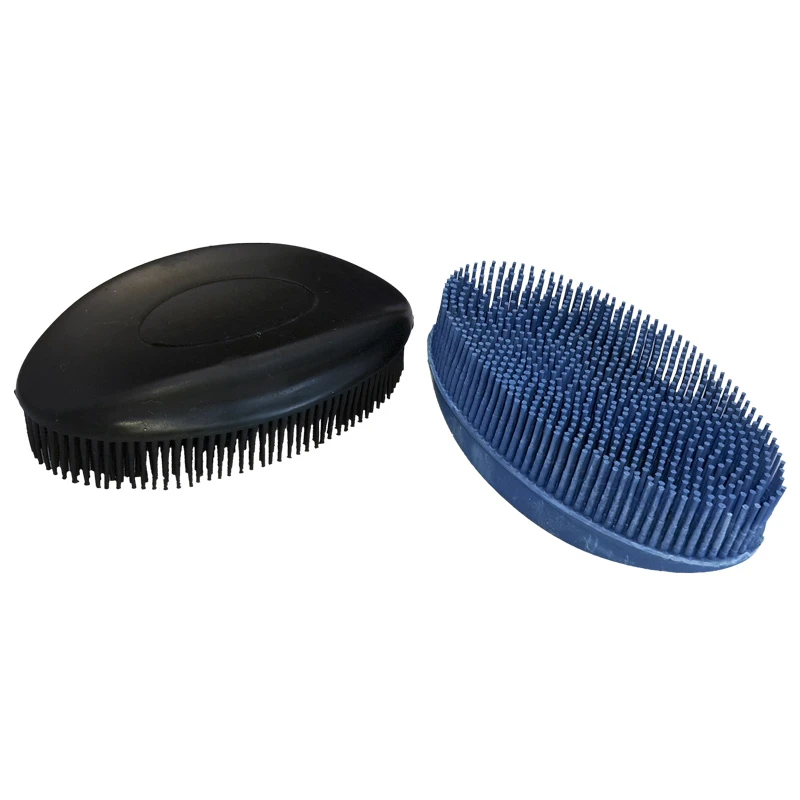
Rubber curry combs
A rubber curry comb is a useful tool in removing dirt, old hair, and debris from your horse. It can be used nearly all over a horse’s body and should be used in a circular motion. Be careful when using this brush on or under areas of the face and below the knees and hocks, as these areas have little muscle, and are sensitive areas.
A metal curry comb is used similarly to be rubber curry comb, however, horses tend to be more sensitive to it. Some horses have more sensitive skin and become irritated by this curry comb. The metal curry comb should not be used on the face or the lower legs.

Plastic curry comb
A plastic curry comb is also useful because it removes dirt and old hair from the horse. Some plastic curry combs have a hose nozzle attachment for use while bathing a horse as well. Be careful when using a plastic curry comb as horses may be sensitive to it.
For more information about grooming, check out How to Groom a Horse and Grooming for Success.
How to Use a Rubber Curry Comb on a Horse
Finding the right curry comb
Go with a rubber curry comb. The workhorse of the curry combs, a rubber version comes in different colors, sizes, and nub depth. You can also choose different flexibilities depending on what you and your horse like. Finding one or two different curry combs to use on your horse will help keep it clean, help blood circulation in the skin, distribute oils, and give your horse's coat a nice shiny glow.
● Be aware that rubber combs shouldn't be used on a horse's face, ears, or legs.
● Throw these in the wash rack for bath time if you like.
Get a curry or pimple mitt
Another version of the rubber curry comb you and your horse might like is the curry mitt or pimple mitt. These pimpled gloves are great to use on sensitive horses as well as sensitive body parts like faces, bellies, and lower legs. You can also use them on other body parts if you like.
● Fold your curry mitt in half to get into your horse's nooks and crannies. For example, you could use this in the horse's “armpits” to clean out sweat stains and massage the area.
● Throw curry mitts into the wash rack for bath time if you like.
Use a jelly mitt
Like curry mitts, jelly mitts are also very versatile. They generally are different sized pimples or nubs on each side for different parts of your horse's body. Unlike other curry combs, you can also use jelly mitts on a horse's lower legs.
● Try using a jelly mitt to loosen hair on saddle pads. The stiffer nubs are also good to remove dried poultice from your horse's lower legs.
Consider specialty curry combs
In addition to standard types of rubber curry combs, there are different shapes, textures, and designs. These are usually for specific body parts or to do things like massage a horse's fascia and muscles. If your horse has specific physical needs or you even just want to give it a treat with something like a massage curry comb, keep one or two of these handy.
● Consider any problems or specific health needs your horse has. Does he or she have tight muscles from training for competitions? Try a cross fiber groomer to help loosen up your horse's fascia and muscles. You could also try a specialty mitt for sweat stains if the horse trains frequently or lives in hot climates.
Be cautious with metal curry combs
Some rubber curry combs are made of hard and inflexible metal that scrape up hair and dirt well. However, they can be too harsh on a sensitive horse and shouldn't be used to brush any bony areas like the shoulders, hips, and legs. Consider using a metal comb in conjunction with a plastic or rubber curry comb for the best results.
● Use the metal comb on your horse only if it likes it. Otherwise, consider using a metal comb to scrape hair and sweat from saddle pads or to clean rubber or plastic curry combs.
● Be aware that metal curry combs don't do well in water, so you may not want to use them at bath time.
How to Keep Your Horse Comfortable with a Rubber Curry Comb
Tie up your horse
Before you start curry combing your horse, tie it up in a safe place. Leaving your horse loose in a stall or without a halter can leave you without any control if the animal tries to turn around or escape from you. Consider giving your horse a treat for allowing you to tie it up. This may also help it stay calm during the rubber curry combbing session.
Remember to be gentle
From the way that you curry comb your horse to how you move around the animal, remember to use gentle movements. This can prevent harming or startling your horse and ensure a pleasurable experience for both of you.
Get your horse used to curry combing
If your horse is young or needs more frequent cleaning, it's important to give your horse time to get used to it. Providing your horse with positive reinforcement and gentle handling can help you more easily get through a rubber curry combing session and teach your horse to love getting clean.
● Try and curry comb your horse any time you ride it. This gets it in the habit of being groomed and can help him or her stand still for longer grooming sessions or even to get new horseshoes. It can also help you detect health problems.
● Give your horse a treat at the beginning and/ or end of a curry combing session. Offer the horse a lot of praise for good behavior. Make sure to take your time so that your horse doesn't sense any urgency or irritation. These behaviors can help your horse get used to curry combing and associate it with positive feelings.
Hold the curry comb properly
Grasp the handle and use your thumb and fingers to hold the comb firmly. If you are using a mitt, slip your hand into it completely and ensure that it won't slide off during your combing.
● Make sure any straps on the rubber curry comb are secure and not broken to ensure optimal use. The same goes for the nubs on plastic combs. Broken parts may hurt you or your horse.
Figure out your horse's favorite comb
Just like humans and other animals, horses often love the feeling of being groomed. This is especially true if you take your time to lovingly groom your horse. However, you may notice that your horse reacts differently to certain combs, which can cue you into what he or she prefers in terms of the rubber curry comb. Try and focus on this comb to help your horse enjoy the grooming process.
● Notice if your horse leans into you, which is a sign that he or she is enjoying that particular comb.
● Look to see if your horse's ears are turned out to the side, which is a sign that he or she is relaxed. Likewise, a dropped head can also indicate relaxation.
How To Groom a Horse's Body
Move the currycomb in circular motions
Starting at the top of your horse's neck, use the curry comb in circular motions on your horse. Work with the direction of the horse's hair as if you were giving the animal a massage.
● Press firmly but gently when currycombing in the direction of the hair. Use lighter pressure if you're going against the horse's hair. Don't be surprised if your horse leans into the curry comb because it likes the feeling!
● Use caution when going back and forth in a scrubbing motion. Some people suggest not using a scrubbing motion while others think it's acceptable if done gently.
Comb over the rest of the body
Work your way around the rest of the horse's body, taking care around bony and sensitive areas. Avoid using the curry comb on the head and mane, lower legs, or other especially sensitive areas for now.
● Check to see that the curry comb is bringing up dirt and dead skin to the surface of the coat. If none is visible, consider going over the area again to prepare it for removal with a body brush.
● Use a different curry comb, such as a jelly mitt or pimple mitt, if your horse appears sensitive to the plastic curry comb.
Pay special attention to the back and girth
A horse's stomach, or girth, and back often collect the most sweat and dirt. Make sure to focus a significant part of your time to curry combing these areas.
● Remember that the girth is often very sensitive. Consider switching to a jelly or pimple mitt to remove sweat and dirt. If this doesn't effectively bring up hair, dirt, and sweat, try using a rubber comb with deeper nubs.
● Check the areas where your horse's saddle sits on its back. Make sure to give this area a lot of attention, too, since sweat and hair can build up underneath the saddle.
Go over bony parts gently
A horse's spine, elbows and legs are very bony. Because of this, they require special care when curry combing them. Use a pimple mitt, jelly mitt, or specialized mitt to curry comb these delicate areas.
● Use the same firm but gentle pressure to curry comb the spine, legs, and elbows. Don't brush too deeply on these parts of the horse's body as they don't have as much muscle and fat as places like the neck or girth.
● Brush sensitive areas in the direction of the horse's hair, just like you would do with other parts. Remember to avoid using a scrubbing motion, which may be especially uncomfortable on sensitive or bony areas.
● Be especially careful when curry combing the horse's legs so that it doesn't kick you. Use the most gentle pressure here so that you don't startle the horse.
Comb the face
Unclip your horse from the lead or where you've tied it up so that you can effectively curry comb its face. Hold the curry comb in one hand and your horse's face in another as you gently work your way around the face. Make sure to avoid the delicate eye area and the horse's mane.
● Work your way from the horse's neck to the jaw, nose, behind the ears and brow band. Pay special attention to these areas because remaining dirt can cause discomfort under the horse's bridle.
● Put the head collar back on or tie up the horse again so that you can finish your curry combing session.
● Use a regular or body brush to comb the mane. Dampen it with some water to remove excess debris and keep the mane flat.
Empty the curry comb
You may find that the curry comb fills up with hair, dirt, dried mud, or sweat as you brush your horse. Occasionally “emptying” the curry comb by banging it against a hard surface can help you more effectively groom your horse.
● Empty your mitt only if necessary. In most cases, debris will simply fall out of mitts without banging it against anything.
Brush off debris
Use a body brush in a flipping motion to remove all of the hair and dirt brought up through curry combing. Make sure to start at the neck and work your way all over the horse's body. This can make your horse's hair supple and shiny.
● Make sure to brush in the direction of the hair. Clean out the brush every few strokes by combing the rubber curry comb with a metal version.
Rubber curry comb
Rubber curry combs have been a horse grooming tool for over a hundred years. The curry comb is a round brush with short teeth made from rubber, plastic, or metal. It has a hand strap or handle to help the groomer grip it and is used for removing caked mud or loosening dirt close to the horse's skin so that other brushes can remove it.
Design: When shopping for a rubber curry comb, make sure that the teeth are long enough to loosen dirt but short enough not to cause discomfort. Rubber curry combs are the best for a horse's skin as they are strong enough to loosen dirt without scratching. Horses more sensitive than others may benefit from softer body curry combs with longer and softer teeth. Other materials like hard plastic and metal could cause discomfort for your horse if they are used too aggressively.
Uses: The rubber curry comb is an essential horse grooming tool that helps remove caked mud from their body and loosen dirt close to the horse's skin so that other brushes can remove it. However, as its teeth could be too aggressive on boney parts of the horse, like their legs and face, these areas should be avoided when using this brush.
Hard brush or dandy brush
The Hard Brush is an essential item to have in your grooming kit. It has long, coarse bristles that are great for removing heavy dirt and dried mud from the legs and face. When choosing a hard brush, the most important factor is the coarseness of the bristles - if you have caked mud, a brush with coarser bristles should be chosen. If the dirt particles are very fine, a hard brush with finer bristles will work best. You should also consider what type of climate your horse lives in and whether your horse often comes in from a muddy pasture.
Design: Hard brushes can either be made from plastic or natural fibers. Plastic brushes last forever and remain effective, but organic brushes must be properly maintained to last longer. Organic brushes are sometimes preferred for their ‘traditional' feel and are slightly more effective than their synthetic counterparts.
Uses: The long, coarse bristles help remove heavy dirt and dried mud from the legs and face effectively yet gently, making it preferable to curry combs in certain cases. Additionally, the coarseness of bristles should be suitable for your horse's environment - those living in muddy pastures might require a harder brush with coarser bristles. In contrast, those living in drier climates will require one that is less harsh with finer bristles.
Soft brush
The soft brush has a very similar build to the hard brush, with the difference being in its bristles which are more flexible, finer, and denser. These properties make it softer on a horse's skin while allowing it to pick up more particles while being used. It removes the smaller dirt and dust particles trapped inside a horse's coat.
Design: Soft brushes are usually made from either gentle synthetic bristles or soft organic fibers. There are many kinds of soft brushes available on the market, with the level of ‘soft' varying between them; some even have a mixture of bristles, some fine and some coarse, to help get the most out of grooming. Generally speaking, plastic is slightly less effective and cheaper but will last longer than organic materials, which are higher in quality and need to be maintained.
Uses: The soft brush can help keep your horse's coat clean by picking up small dirt particles that may be present within their fur. It also helps make their mane and tail look silky smooth without causing any damage to their hair by using gentle synthetic or organic bristles instead of coarser materials like metal or rubbers.
Body brush
A body brush is easy to recognize because it typically has short bristles with a hand strap and an oval-shaped handle. The shorter, denser bristles reach down to the base of your horse's skin to remove dust and dirt particles while massaging and releasing oils at the same time.
Design:Many different kinds of body brushes are being sold today in varying levels of softness, from soft to medium. It is best to have a soft body brush for your horse's face and a harder, medium body brush for their body; however, one can suffice if on a budget. The material of body brushes should ideally be organic as this works best for releasing oil from the horse's skin.
Uses:Body brushes help keep your horse's coat clean by removing dust and dirt particles while also giving them a massage which helps release oils that give their coat a glossy shine. They also help spread the oils along their hair shaft, which makes it look healthy and shiny.
Mane and tail comb or brush
Mane and tail brushes or combs typically look like the brushes used on human hair; however, since horsehair is much coarser, mane combs are much sturdier. They are usually made from plastic, rubber, or metal and are used to brush out a horse's mane and tail.
Design:When buying mane and taween the comb or brush teeth (plastic or metal), as it may slice or snap your horse's hair. Look for brushes with wider-spaced teeth as they are gentler on horsehair; plastic combs are generally less aggressive than metal combs as they are less likely to pull out your horse's hair. The best mane and tail brushes should have a smooth surface with flexible teeth; this will minimize the breakage of your horse's hair while you comb it.
Uses:Mane and tail brushes/combs can help keep your horse's mane and tail in top condition by removing knots, dirt, and debris, which helps prevent damage to the hair. It also allows air to circulate freely around the hair follicles, promoting healthy growth.
Face brush
This is a small, soft brush or body brush used specifically for grooming your horse's face.
Design:These brushes are typically about one-third the size of normal brushes and are better for grooming around the curves of a horse's face.
Uses:Face brushes are often good for young children to use when learning to brush since they are so small.
Finishing brush
A finishing brush is similar to a body brush and is used at the end of grooming to ‘finish' your horse's coat.
Design:The brush has long soft bristles made from organic material that help guide your horse's natural oils across its coat to make it shiny.
Uses:The finishing brush removes small traces of dust that might have built up from grooming and leaves your horse looking its best.
Water brush
The water brush is an extremely coarse plastic, hard brush used to clean other brushes or buckets used for grooming.
Design:These are handy to have as they clean brushes better than a curry comb or a shedding blade.
Uses:The water brush is a useful cleaning tool for all of your grooming supplies.
How to Clean Your Rubber Curry Comb
Now and again (I aim for weekly or so), I will do a deep wash with all of my brushes and rubber curry combs. I usually end up also washing the brush box, too, as that tends to be a collection of hair and dust and gunk.
01
A good soak and scrub in warm water with Nolvasan (AKA chlorhexidine) solution or even a mild horse shampoo will work well. I will use a bucket or my tack box to hold my solution and then swirl it all around and let it soak for a few minutes.
02
Rinse thoroughly with warm-ish water for a few minutes. I like to dry my brushes with the bristles facing down or to the side. A wooden brush handle will get too wet if the bristles drain into the wood.
03
I have a laundry rack that unfolds, which is perfect for drying brushes and blankets. You can also dry in the grass, on the ground, or any place out of the way of curious horses.Drying your brushes on their side is an excellent way to preserve the handle.
04
Because my horses have their own set of grooming tools that are not shared amongst the barn, I may be able to go a bit longer between deep cleanings. When each horse has their own set, this allows for easy containment of skin issues, like rain rot, that can be transmitted from horse to horse.A nice bath in some Nolvasan solution or mild shampoo does the trick.
05
Our Factory
Yangzhou Peiyu Tools Co.,Ltd was founded in 2014,We have advanced equipment, strong technical force, the production of the product type is complete, reasonable price, timely delivery, all of our products are exported to Europe and the United States, Russia, southeast Asia and other countries and regions.
we are specialized in supplying and developing brushes for horse and other animals.Our leading merchandise includes:Horse brush,Horse grooming kit,Hoof pick,Sweat scraper,Bucket,Stall fork and so on.
We always improve our work to meet customers' different requirements.

Our Certificate

Asked Questions
Q: How do you use a rubber curry comb?
Q: What does a rubber curry brush do?
Q: Why is it wrong to use a curry comb on the lower part of a horse's legs?
Q: What is the difference between rubber and metal curry combs?
Q: How do you clean a rubber curry comb?
Q: How do you clean a rubber curry brush?
Q: Why is it called a curry comb?
Q: Are curry combs good for dogs?
Q: What type of creature is a curry comb used on?
Q: Where should you not touch a horse?
Q: Which part of the horse should never be allowed to get wet?
Q: Where should you not brush a horse?
Q: What are the different types of curry combs for horses?
Q: What is a hard rubber comb used for?
Q: What is the best brush for a muddy horse?
Q: How do you deep clean rubber?
Q: What happens if a rubber comb is run through dry hair?
Q: What does a rubber curry comb do for a horse?
Q: Can you use a rubber curry comb on a cat?
Q: What is the best rubber curry comb for short hair dogs?
We're professional rubber curry comb manufacturers and suppliers in China, specialized in providing high quality customized service. We warmly welcome you to wholesale high-grade rubber curry comb made in China here from our factory.
Rubber Curry Brush Horse, Rubber Curry Comb, Curry Brush for Horses