


Mane and Tail Brush
What is Mane and Tail Brush
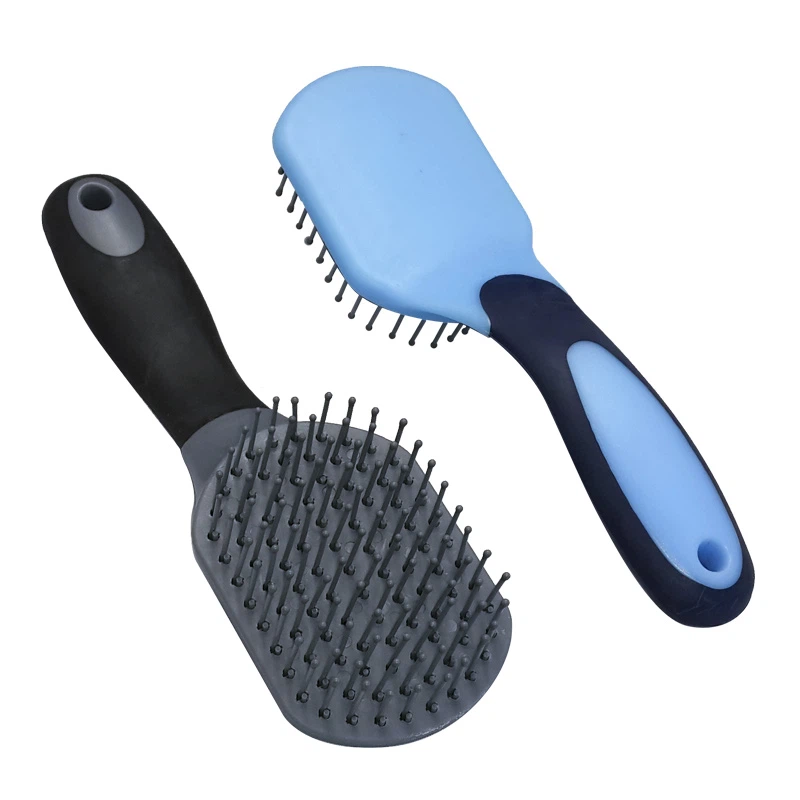
The mane and tail brush is designed to gently detangle the mane and tail. Equipped with plastic bristles that are durable enough to detangle manes yet gentle enough to ensure your horse's comfort.
Benefits of Mane and Tail Brush
Grooming is natural for horses: When horses are living outside in a herd situation, they groom one another naturally, but stabled animals don't see this benefit. Therefore, you will be replicating an essential process for your horse and probably doing an even better job.
Improves skin and coat health: By mane and tail brush your horse during grooming, you are stimulating blood flow to the skin, which helps to keep the skin in good condition. You are also promoting the release of essential oils that result in a lustrous coat. In addition, you will be massaging large muscle groups to keep them relaxed and supple.
Decreases the chances of skin issues: By regularly cleaning your horse's coat and hoofs, you will be helping them to avoid health issues like thrush, rain rot, and scratches.
Ensures chafing does not occur beneath tack: When you groom your horse before riding, it ensures that their coat is clean, which, in turn, reduces the chances of chafing once you put on their tack and head out. This means that their riding session will be nice and comfortable.
Allows the rider to spot the first signs of serious health issues: Spending time grooming your horse on a regular basis means that you will be much more likely to spot potentially serious health issues or injuries before they become a major problem. You can then seek veterinary care while the condition is easily treatable.
Increases the bond between horse and rider: For a herd, grooming is a social action that sees the horses caring for each another. By performing it yourself, you will begin to develop a real sense of trust between you and your horse as they become comfortable being in your presence. This will have benefits for your riding, too, as your horse will gradually become more responsive to your instructions.
Improves their mood and wellbeing: Like humans, horses are emotional animals, and a grooming session can help them to relax and feel happier. A horse that is in a good mood is always going to be a better ride than one that's feeling scared or stressed.
It's an opportunity to run through some exercises: Depending on your schedule, you may not have time to ride every day. However, a time-efficient grooming session can give you an opportunity to practise standing ground exercises with your horse, such as neck flexions, carrot stretches, or leg extensions, which can boost flexibility and balance.
It's good exercise for you: While grooming has many benefits for your horse, it will also deliver a healthy workout for you. Brushing every inch of a horse's coat can take a bit of effort, so you'll also experience a nice health and fitness boost.


Why Choose us
Quality services
Our team is committed to delivering high-quality services to our clients. We use the latest technologies and tools to ensure that our services exceed your expectations.
01
Quality
We offer high quality services and products that are relatable and resonate with your business needs.
02
Experience and expertise
Our company has been in business for many years and has amassed significant expertise and experience to provide quality services to our clients.
03
Competitive pricing
We offer competitive pricing for our services without compromising on quality.
04
Certifications and quality standards
Choose a factory that adheres to industry standards and certifications to ensure product safety and quality.
05
What Do You Need In A Horse Grooming Kit?
Mane and tail brush
What is it? A mane and tail brush are two horse grooming tools used to groom a horse's mane so that it doesn't get tangled or matted, or even to style it. Horses with shorter pulled manes will typically require a mane comb, which is wide toothed and made with metal or plastic. Longer lengths will need a mane brush that is quite similar to a human hairbrush in its design.
How is it used? Mane brushes are quicker to use as they can be utilised in a sweeping motion that quickly flattens the hair. A mane comb, on the other hand, needs to be gently dragged through the hair and can be used to thin the mane, by using a technique called mane pulling, in preparation for plaiting.Where is it used? The horse's mane – although many people use a body brush for day to day grooming purposes

Curry comb
What is it? A curry comb is a short-toothed horse grooming comb made with rubber or plastic that is used to rub or “curry” the horse to loosen hair, dirt, and other particles, as well as stimulating the skin for healthy blood flow and the production of natural oils. There are also metal curry combs used for tougher tasks and brush cleaning purposes.
How is it used? The curry comb typically has a handle on its reverse that the rider's hand can slip into in order to perform the circular motion needed to dislodge debris. It can also be used in quick, short motions following the direction of the hairs.Where is it used? All over the horse's body but not on legs or the head.
Dandy brush
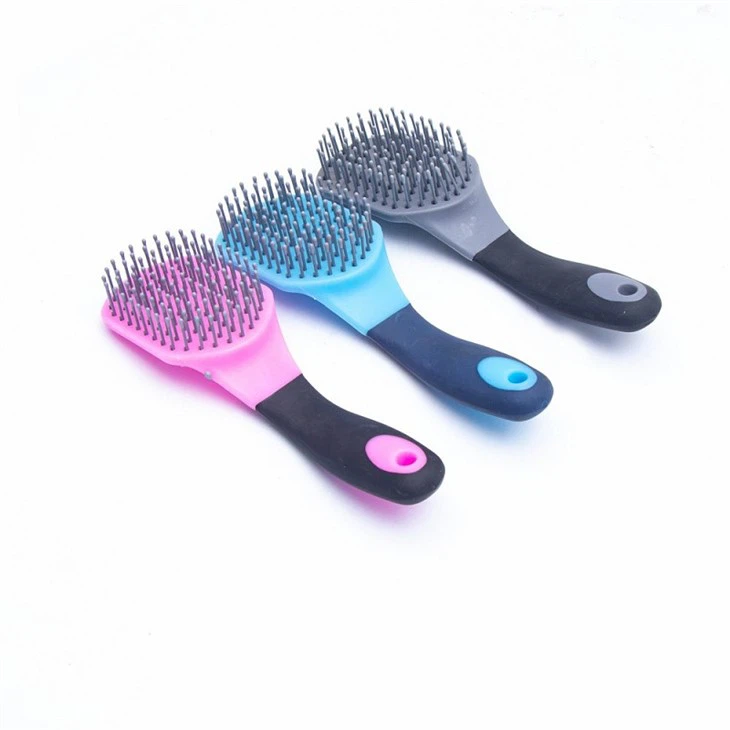
What is it? A dandy brush is a horse grooming brush that has long, stiff bristles in order to remove the dirt, hair, and other debris that has been brought up by the curry comb. These brushes are most commonly made with plastic bristles, though more expensive versions can have natural bristles, such as rice stems.
How is it used? The dandy brush is used in short strokes in the direction of the horse's hair growth except for the flanks, where the hair grows in a different pattern. Some dandy brushes can have water applied to them and be used as water brushes to wet down hair.Where is it used? All over the horse's body but not the legs or the head.
Body brush
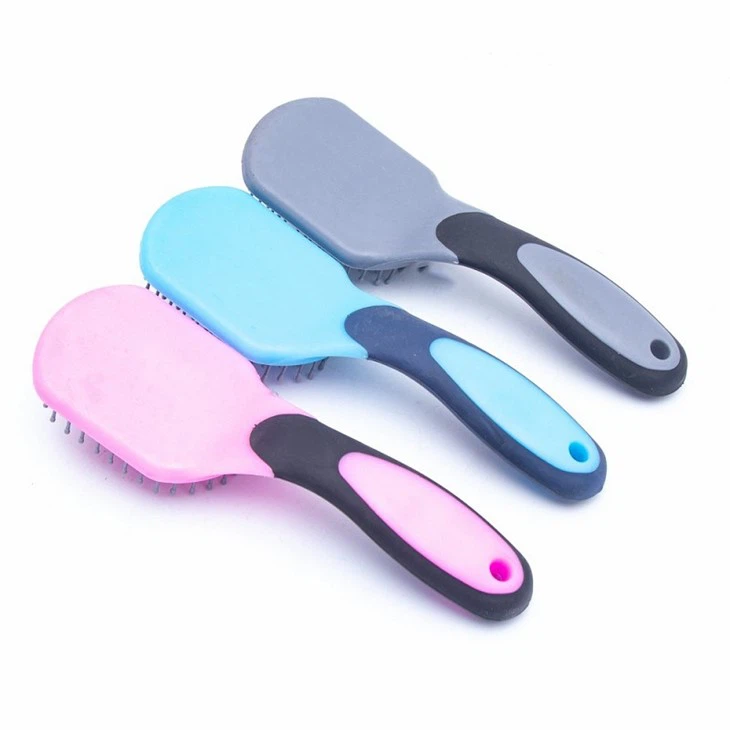
What is it? A body brush is a soft-bristled horse grooming brush used to remove particles and grease from the coat, as well as to provide a soothing sensation to the horse. These brushes are made with either natural fibres, like horsehair, goat hair, or boar bristles, or from soft, synthetic fibres. There are also versions that are smaller and designed for use on the face.
How is it used? The body brush is used with long, sweeping strokes to smooth the coat and bring natural oils to the surface. Usually, these brushes need to be rubbed against a metal curry comb regularly to remove dust, so it doesn't find its way back into the horse's coat.
Where is it used? These soft brushes can be used all over the horse's body, though a smaller brush may be required to carefully tend to the face.

Metal curry comb
What is it? Metal curry combs are similar in design to plastic curry combs but are made with metal for a tougher finish. They still have rows of serrated teeth and a handle.
How is it used? The main reason they are essential is because they are used to clean other grooming brushes due to the effectiveness of their blades at removing debris from fibres. It's chiefly for this purpose you'll need one in your kit.
Where is it used? A metal comb can be used to remove dirt from brushes by moving their bristles brushes across its teeth.

Sponge
What is it? A soft sponge used to clean in and around the more delicate areas of a horse and to wet down and wash large areas of the body and the legs. It can also be used to clean wounds.
How is it used? The sponge is dampened and then applied to the horse. Delicate areas will require a small sponger and gentle motions, while washing down bigger areas can be done with a large sponge and broader actions.
Where is it used? A small, soft sponge should be used to clean the face, especially around the eyes, nose, ears, and lips. A separate small sponge should be used to wipe down the dock and groin. The body and legs can be tackled with a larger sponge.

Stable rubber
What is it? A linen or terrycloth (or similar) grooming towel or sheepskin mitt.
How is it used? A stable rubber is typically dampened and used to give the horse's coat a final polish after grooming. One can also be used to absorb moisture when drying or after a ride to remove any sweat, although the latter can also be performed with a sweat scraper.
Where is it used? The stable rubber can be used all over, though care should be taken around the face and other sensitive areas.

Hoof pick
What is it? A hoof pick is a hooked tool with a handle, usually made of metal or plastic, used to remove dirt, mud and stones that get packed into the sole of a horse's hoof. They can also be used to remove hard-packed snow during the winter.How is it used? The horse’s foot is lifted so that the bottom of the hoof is reachable, then the rider picks out the trapped debris from heel to toe. All four hoofs are cleaned before and after riding.
How To Groom Your Horse With A Mane And Tail Brush Step By Step
Tie up your horse
Before you start your horse grooming routine, it's best to tie them up to a post or beam to ensure that they stay in place. Even if your horse usually stays in one spot, they may shift their weight or move their feet during grooming, so it's best to take this precaution.
Try to tie their lead rope to somewhere that's above the height of their withers (shoulders) and only use a quick-release knot, also known as a “highwayman's hitch” (you can find an easy tutorial here from Animated Knots). Ideally, your lead rope should attach to a piece of baling twine, attached to the beam or fence (or similar), as in an emergency, should the horse pull and get spooked, the twine can be broken.
Clean your horse's hoofs
To start, you need to pick up your horse's foot so that you can access it with your hoof pick. Stand at their side facing in the opposite direction to them and adjacent to the leg you want them to lift. Have your hoof pick ready in the hand furthest from them. Run your other hand down their foreleg until you are cupping the hoof, and slowly lean in until they shift their weight, which hopefully causes them to pick up their foot. If this doesn't work, you can try gently squeezing the tendons above their pastern (the sloping part between hoof and fetlock).
Next, keeping the lifted hoof supported in your hand, use the hoof pick to gently remove any debris that is stuck to the bottom of their foot. Work from the back to the front, which will ensure you do not accidentally jab your horse's leg, foot, or yourself, and clean out any dirt from around the frog (the fleshy “V”). If your horse is shoed, pick around the inside of the shoe to remove any pebbles, or, if your horse is barefooted, clean around the area where the bottom of the hoof meets the edge.
When you've got the hoof clear of debris, take a moment to check for any signs of injury or illness. A common problem is thrush, most obviously signified by a dark discharge from the frog area. Inspect the wall of the hoof (raised edge) for any cracks that may need attention from your farrier. Then, you can gently place your horse's foot back on the ground and move onto the next one.
Curry your horse
With all of your horse's hooves picked and inspected, it's time to pay attention to their body. Start by using your curry comb to loosen the dirt in their coat. As you go over their coat, you should see dirt particles rise up from the skin for easier brushing later.
Begin on their left side, working from ear to tail, avoiding the head, mane, tail, and lower legs, and taking care when going over bony sections of the shoulders, hips, and legs. Use circular motions, applying gentle pressure to dislodge any unwanted particles. Should your horse flatten their ears or swish their tail, they're indicating their discomfort, so ease off and curry more gently. Use the opportunity to check for any skin lesions or wounds as you go.
Brush away dirt and debris
Now you've dislodged all the dirt from your horse's skin, it's time to brush it off. So, grab your dandy mane and tail brush and use short flicking motions to whisk away the debris from their coat. You'll need to cover the same areas you've just gone over with the curry comb, still avoiding the head, mane, tail, and lower legs. Begin at the neck and work your way around the horse, following the direction of hair growth.
Use a body brush to add shine
The last brush you'll be using on your horse's coat is the body mane and tail brush, which has softer bristles that are perfect for adding a luxurious shine. Thanks to this gentler touch, it's safe to use this brush on your horse's head and legs, though you might need to use a smaller body brush for the face.
Starting at the head, work your way along the body and then down the legs. Use long, sweeping strokes in the direction of hair growth to whisk away any particles left by the dandy brush and to smooth down the hairs. Take care to use shorter sweeping strokes on the lower legs just to make sure that your horse is nice and comfortable.
Pay attention to sensitive areas
After grooming your horse's coat, you'll need to clean the sensitive face and dock (under tail) areas. Use a dampened sponge or stable rubber cloth to gently wipe around their eyes, ears, and muzzle, taking extra care not to cause discomfort. It's also worth checking for any signs of eye infections, like excessive tearing, swelling, or redness, as well as checking your horse's ears for lodged dirt or seeds. Be careful when cleaning or handling the ears, as some horses are very sensitive.
Next, you'll need to wipe your horse's dock area beneath the tail. Be sure to use a different sponge or cloth for this area for hygiene reasons, and take care to be very gentle with this sensitive area.
Comb through the mane and tail
To get a flowing, shiny mane and tail, you'll need to carefully detangle and comb them. Begin by working through the worst snags in the mane with your fingers, getting them separated as best as possible. Then, use your mane mane and tail brush to straighten out the hairs, working on small sections at a time and from the bottom upwards. An effective method is to gently grasp the top of the area you're working on with one hand and run the brush or comb through the hairs with the other. This should avoid any tugging.
When you are doing the same with the tail, you need to stand slightly off to the side, pulling the tail gently towards you. This will ensure that you're out of kicking range should your horse get spooked. Depending on the condition of your horse's tail, you can also consider using a stiff-bristled brush to brush through the mane and tail.
The Mystery of the Mane and Tail Brush
Before there were planes, trains, and automobiles, and other engine-driven devices, people of the 18th, 19th and early-20th centuries used horses, mules, and other four-legged draft animals to transport themselves, pull their wagons and carriages, and help manage the chores of farm and rural life.
Just like the time and expense we currently spend on car, truck, and small engine maintenance to keep those running smoothly, an equal amount of attention is essential to keeping horses healthy, clean, and physically fit so that they can perform the tasks we ask of them. The process of grooming a horse not only improves the health of their skin, coat, hooves, mane, and tails but it also allows the groomer to notice any health issues or problems that aren't apparent until seen up close.
A mane and tail brush, an essential horse grooming tool, was excavated at George Washington's Ferry Farm from an early nineteenth-century context. This rusty iron alloy comb is incomplete, measuring two inches high with a broken width of 1 ¼ inches. The finished width might have been between 3 and 4 inches. What makes this find interesting is that there is a decorative “G” inset above the comb's teeth. This letter was obviously followed by others, but what the complete word or initials indicate is a complete mystery.
Mane and tail brushs are just one piece in any essential grooming kit for horses, which also includes curry combs, brushes, hoof picks, and grooming cloths. The mane comb is used to comb out the tangles and remove debris from the mane and tail of horses. It can be very simple and utilitarian in looks, similar to a common hair comb, or more ornate and decorative, such as this example that is stored on a leather backing. Our mane comb falls between these two extremes. It does not have an elaborative top but it is still decorated within the handle area with a swirled scroll, raised beading along the outer band, and the letter “G–”.
So if there are any horse-loving readers out there who recognize this style of mane and tail brush or have a clue as to what “G” could be the start of, please let us know. We may never know but we do hope that maybe the “G” is the beginning of the name of our site's most famous horseman, George, who was certainly well known for his horsemanship skills!
The Role Of Grooming Your Horse With A Mane And Tail Brush
Grooming gets your hands on your horse.
A good daily groom doesn't have to take an hour. If you do it daily, your average time expenditure should actually be minimal. But during this daily routine you have an opportunity to get your hands on every inch of your horse, and what better way to quickly assess your horse's health?
This is in effect what I do during a physical exam. Touching the animal tells you so much more than just looking at it over the fence. Is the horse sensitive in a particular area? Are there any weird lumps or bumps? Any rashes, scratches, or swellings? A good grooming session will let you pick up on these things before they become a major issue.
Grooming acts as preventive medicine.
A good grooming session increases blood flow to the skin's surface, massages large muscle groups, and daily hoof picking keeps the feet clean and helps prevent common hoof issues such as thrush, a bacterial disease of the sole. Horses out in the wild don't have this luxury, but they have each other, and mutual grooming takes the place of mane and tail brush.
When you remove a horse from its natural environment and stick it alone in a stall, you need to take on the responsibilities of herd mates for the health of the individual.
Grooming increases the human-animal bond.
True, there are some horses out there that don't like to be groomed. But the majority does tend to enjoy it and this is a great opportunity to bond with your riding companion. Engaging your horse in an activity where you are not requiring him to actually perform any work is a release from the demands we push on our riding mounts. This is your chance to give back and let your horse relax.
Quiet time with just you, your horse, and a mane and tail brush can communicate feelings of communal pleasantries that benefit both horse and rider. For those just starting a relationship with a new mount, this is a wonderful way to build a bond, and for those beginning training with a young horse, grooming can re-assure an anxious green mount.
Grooming can be more than a brush in hand.
Sometimes, if you don't have time to ride, a grooming session can substitute. Practicing some ground exercises such as lateral neck flexions or picking up hooves and doing some leg extensions are great equine yoga moves to help with flexibility and balance. Some people take the time to practice ground manners or teach their horses tricks. It's amazing what you can do with your horse if you only have twenty minutes in the evening after work.
Grooming is excellent exercise — for you.
So, this is a purely selfish reason for encouraging people to take the time to groom, but how many of you have worked up a sweat just brushing your horse? Working that body brush over the top line will definitely work your shoulders and triceps if you are doing it right! Who needs a gym membership when you have horses, right?
Our Factory
Yangzhou Peiyu Tools Co.,Ltd was founded in 2014,We have advanced equipment, strong technical force, the production of the product type is complete, reasonable price, timely delivery, all of our products are exported to Europe and the United States, Russia, southeast Asia and other countries and regions.
we are specialized in supplying and developing brushes for horse and other animals.Our leading merchandise includes:Horse brush,Horse grooming kit,Hoof pick,Sweat scraper,Bucket,Stall fork and so on.
We always improve our work to meet customers' different requirements.

Our Certificate

Asked Questions
Q: How often should you brush a horse's mane and tail?
Q: What is the purpose of a mane and tail brush?
Q: How do I stop my mane from rubbing out?
Q: How often should you pull a horses mane?
Q: How often should you wash your horse's mane?
Q: What are the benefits of mane and tail?
Q: Can you use mane and tail on human hair?
Q: Does mane and tail help human hair?
Q: What is a magic brush for horses?
Q: What is the best brush for a muddy horse?
Q: What do you call someone who teaches horse riding?
Q: Why is my horse's mane breaking off?
Q: Why is my horses mane on the left?
Q: How can I encourage my mane and tail to grow?
Q: How can I help my mane and tail growth?
Q: Can you use mane and tail as a leave-in?
Q: Do horses feel when you pull their mane?
Q: Should you brush your horse every day?
Q: How often do horses need to shower?
Q: How do I keep my horse's mane clean in the winter?
We're professional mane and tail brush manufacturers and suppliers in China, specialized in providing high quality customized service. We warmly welcome you to wholesale high-grade mane and tail brush made in China here from our factory.
Mane and Tail Brush, Mane Tail Brush, Mane and Tail Brush for Horses